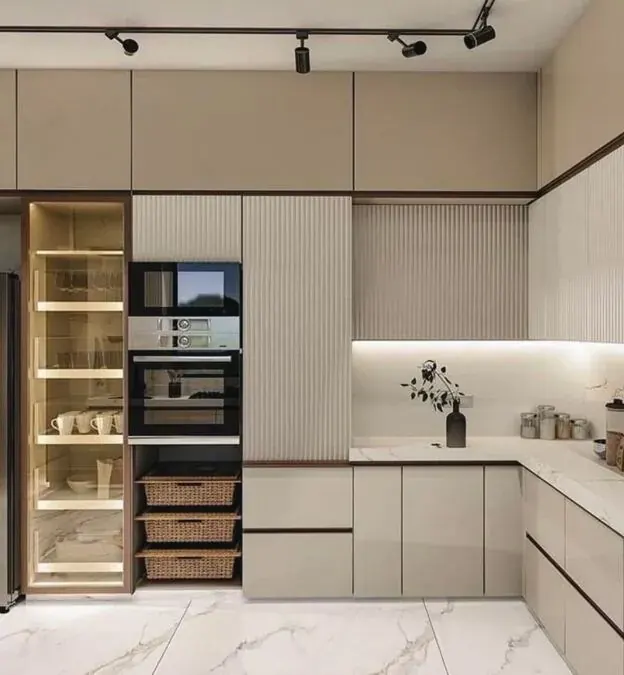
Almost every homeowner who's just taken possession of a new flat asks the same question: should I go modular, or get a local carpenter to build my kitchen the traditional way? The two look similar in a finished photo, but the process, cost structure and long-term durability are very different.
How a traditional kitchen is built
A traditional kitchen is built on-site, piece by piece, usually from plywood or MDF sheets cut and assembled by a local carpenter directly in your home. Measurements, cutting and joinery all happen on location, which means the final quality depends heavily on that one carpenter's skill and the working conditions on site — dust, humidity and rushed timelines all affect the result.
How a modular kitchen is built
A modular kitchen is designed first — usually in 3D — then manufactured in individual, factory-made cabinet modules (boxes) at a dedicated facility, under controlled conditions with precision machinery. These modules are then transported to your home and simply assembled and installed, rather than built from scratch on-site.
Key differences at a glance
- Precision: Factory-cut panels are dimensionally accurate; site-cut panels depend on the carpenter's tools and skill that day.
- Timeline: Modular installation typically takes days once modules arrive, since most of the work already happened at the factory. Traditional kitchens can take weeks of on-site carpentry.
- Finish options: Modular kitchens offer factory-applied finishes — laminate, acrylic, PU, lacquered glass — that are far more consistent and durable than site-applied paint or polish.
- Storage design: Modular systems come with engineered accessories — soft-close hinges, pull-out baskets, corner units, tandem boxes — that are difficult for a carpenter to replicate on-site.
- Cost transparency: A modular quotation is itemized against a fixed 3D design, so you know the exact cost before work starts. Traditional carpentry is usually priced per running foot with verbal estimates that tend to shift as work progresses.
- Warranty: Modular kitchens typically come with a documented warranty on hardware and finish. Traditional carpentry rarely offers this in writing.
Is modular always more expensive?
Not necessarily. Basic modular kitchens with laminate finish can be priced comparably to good-quality carpenter work — the real cost difference shows up as you move to premium finishes and imported hardware. What you're really paying for with modular is precision, consistency, and a documented process — not just the material itself.
Which one should you choose?
If you value a fixed timeline, a written quotation, factory-level finish consistency and a documented warranty, modular is the safer choice — especially for a newly possessed flat where you're managing multiple vendors at once. Traditional carpentry can still work well for very small budgets or highly custom one-off requirements, but you'll need to manage quality control yourself, on-site.